

Why Sanitary Pads Should Be Free in South Africa
Menstrual Health Is a Human Right, Not a Luxury
Every month, millions of girls and women in South Africa menstruate. Menstruation is a natural biological process, yet many are forced to choose between buying sanitary pads and buying food. No girl should have to miss school, use unsafe materials, or lose her dignity simply because she cannot afford menstrual products.
South Africa already provides free condoms through public health facilities because preventing disease and promoting public health is recognised as a government responsibility. Menstrual hygiene deserves the same level of commitment. Unlike condoms, menstruation is not a choice. Every girl and woman of reproductive age experiences it for approximately 35 to 40 years of her life.
Period Poverty in South Africa
Period poverty remains one of the country’s hidden crises. Research has shown that many girls miss school because they cannot afford sanitary products. Studies estimate that around 30% of South African girls miss school during their menstrual periods, while millions of women and girls struggle to afford basic menstrual hygiene products. This negatively affects education, confidence, and future employment opportunities.
Missing several days of school every month can add up to more than a month of lost learning each year. Learners who repeatedly miss lessons are more likely to fall behind academically and, in some cases, drop out of school altogether.
The Economic Burden
A packet of quality sanitary pads typically costs between R40 and R100, depending on the brand and absorbency. A woman generally requires one or more packs every month.
For families already struggling with unemployment, rising food prices, electricity costs and transport expenses, buying sanitary pads becomes another financial burden. This forces many girls and women to use newspapers, toilet paper, old cloths or other unsafe alternatives.
Providing free sanitary pads would not only protect dignity but also improve education, health and economic participation.
The Hidden Cost of Cheap Pads
While affordability is important, poor-quality sanitary pads can create additional problems.
Cheap sanitary pads are often made with lower-quality absorbent materials that may:
Cause skin irritation and painful rashes.
Leak more easily, causing embarrassment and anxiety.
Have poor breathability, increasing discomfort.
Contain lower manufacturing standards.
Recent South African scientific research has also detected endocrine-disrupting chemicals (EDCs) such as phthalates, bisphenols and parabens in several sanitary pad brands sold in the country. These chemicals were detected even in some products marketed as being free from harmful chemicals. Researchers stressed that more studies are needed to determine long-term health impacts, but repeated exposure has raised legitimate public health concerns.
The research does not prove that using these products causes disease, but it highlights the need for stronger quality standards, greater transparency and better regulation of menstrual products sold in South Africa.
Health and Dignity
Lack of access to quality menstrual products can result in:
-Skin irritation and rashes.
-Increased discomfort.
-Anxiety and loss of confidence.
-Poor concentration at school and work.
-Greater risk of infections when unsafe materials are used or products cannot be changed regularly.
The United Nations Population Fund (UNFPA) states that menstrual products should be safe, effective, acceptable and affordable, and that women and girls should be able to manage menstruation with dignity and privacy.
Why Government Should Act
Government already invests in healthcare, education and social protection because these services improve the quality of life of citizens.
Providing free sanitary pads would:
-Increase school attendance among girls.
-Reduce period poverty.
-Protect women’s dignity.
-Improve menstrual health.
-Reduce inequality.
-Support gender equality.
-Help ensure every girl has an equal opportunity to succeed.
Free sanitary pads should be available at:
-Public schools.
-Universities and TVET colleges.
-Public clinics.
-Community health centres.
-Government offices serving vulnerable communities.
Batho Movement’s Position
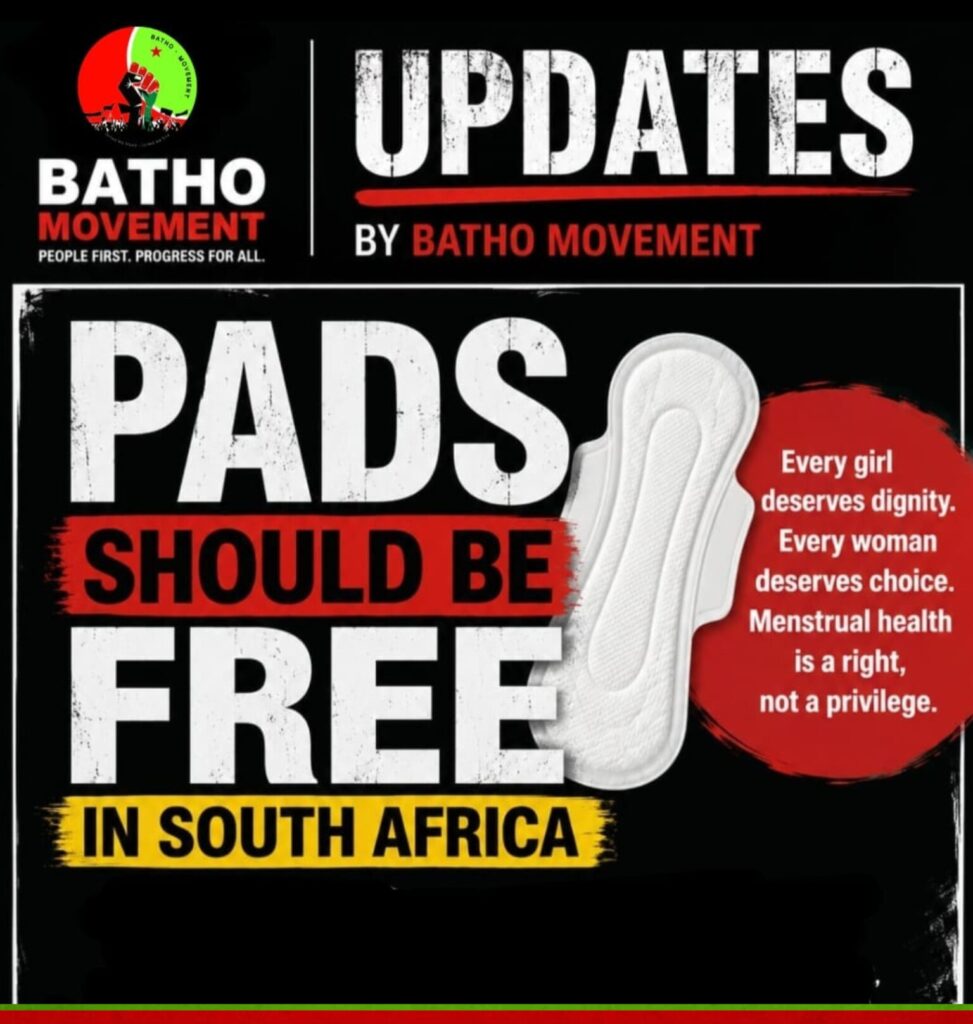
Batho Movement believes that quality sanitary pads should be free for every girl and woman who cannot afford them. Access to menstrual hygiene products should never depend on income.
We also call for:
-National quality standards for all menstrual products.
-Independent safety testing.
-Transparent ingredient disclosure by manufacturers.
-Stronger regulation to protect consumers.
-Sustainable funding for free menstrual hygiene programmes.
A country that can provide free condoms can also provide free sanitary pads. Girls should never miss school because of their periods. Women should never be forced to choose between buying food and protecting their health and dignity.
Quality sanitary pads are not a luxury they are a necessity, a matter of public health, and a basic human right.
Leave a Reply